How to make friends online through shared humor
To make friends online, join a community around an interest you actually enjoy, reply to something specific, and return to conversations where the interest goes both ways. Memes can give you a starting point: add a small detail about yourself and an easy question instead of sending an image and waiting. Ask before moving to private chat, and let an unanswered message stay unanswered.
How to make friends online: choose a place you can join in
Look for a community where people talk to each other, not just an endless feed of jokes. Before posting, read a few recent discussions and check the rules. Can newcomers contribute? Do replies get actual answers? Is there a clear way to report harassment?
Choose the setting based on what you want to do together:
- A hobby group gives you a shared activity: games, drawing, reading or making things.
- A fandom discussion gives you shared references. Check spoiler rules before dropping the punchline.
- A meme community gives you shared humor. Look for conversations you can add to, rather than treating every post as an audition.
Start with one place you’d still enjoy if you didn’t make a friend immediately. That gives you a reason to return without turning every reply into a friendship application.
Turn a meme into a question someone can answer
A useful opener has three parts: a reference to the joke, a little about you, and a question tied to it. The question should invite a reply without asking for private information.
Here are possible replies you can adapt:
| The joke is about… | A reply that opens a conversation |
|---|---|
| Too many browser tabs | “Mine has three tabs for hobbies I haven't started. Which hobby is haunting yours?” |
| A game’s impossible tutorial | “I failed the part labelled ‘basic movement.’ Which bit got you?” |
| An exhausted social battery | “Quiet co-op games are my recharge mode. What's yours?” |
| A character’s terrible decisions | “I was defending them until that episode. When did you give up?” |
Use a question you actually want answered. A copied opener about a game you don’t play gives you nowhere to go when someone replies.
SocialSelf’s guide to starting a conversation online also recommends having a clear reason to contact someone and following up on a topic you’ve already discussed. A meme can supply that reason; your reply does the conversational work.
A worked example: from browser tabs to guitar talk
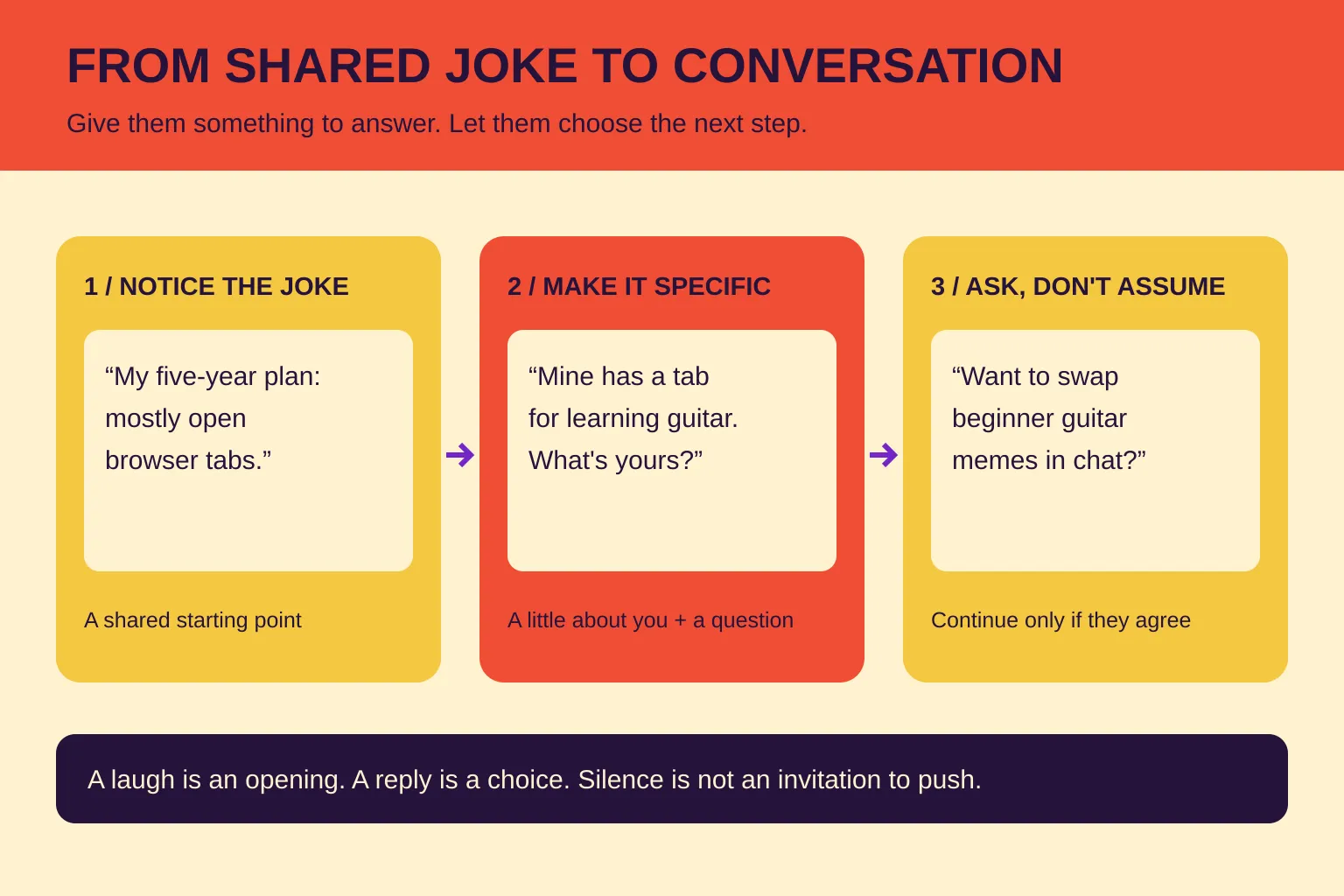
Say you’re in a hobby community and someone posts: “My five-year plan: mostly open browser tabs.” You reply:
“Mine has a tab for learning guitar that's been open forever. What's yours?”
They answer: “Same. Bought one and can barely change chords.”
Now respond to what they said, rather than firing off another unrelated meme:
“I'm stuck on switching to C. Are you learning songs or doing exercises?”
If they answer and ask about your practice too, you have a topic to continue. If the exchange stays one-sided, leave it there. You don’t need to squeeze a conversation out of a reaction emoji.
After you’ve had a back-and-forth you both seem to enjoy, ask:
“Want to swap beginner guitar memes in chat, or keep it in this thread?”
Wait for agreement and follow the community’s messaging rules. A funny reply is permission to answer that reply, not permission to fill someone’s inbox.
Keep in touch with something you already share
When you return, pick up a detail from the conversation. “Did that chord switch get any easier?” gives the other person something familiar to answer. Share your own update too, so they’re not carrying an interview.
If chatting becomes mutual, suggest one small shared activity: playing a game, comparing a drawing prompt, or talking about the next episode. Make the invitation easy to decline: “I'm trying that drawing prompt this weekend. Want to compare results here?”
You can stay text-only if that suits you both. Friendship doesn’t require a selfie reveal or a deadline for a call.
Know when to stop—and when to block
Don’t read shared humor as proof of trust, romantic interest or compatibility. Notice how the person treats you when the joke is over.
- If they don’t reply, don’t send a stack of follow-ups or chase them through another account.
- If a joke lands badly, say “Sorry, that missed” and change course. Don’t demand that they explain why they aren’t laughing.
- Avoid jokes targeting the person’s body, identity or vulnerabilities. Shared interest is a better starting point than testing their tolerance for insults.
- Keep your address, passwords, financial details and identifying daily routine private. Don’t send money or private images because someone pressures you.
- If someone harasses you or ignores a boundary, stop engaging and use the platform’s block and report tools.
Make a meme from your own shared experience
If you’d rather start with an original joke, use a familiar situation and change the punchline to match the community’s interest. “Me: one quick practice session / Also me: tuning for twenty minutes” gives fellow beginners something specific to recognize.
Demon Match is our photo-free meme community: make a meme with an original graphic template, then build your free photo-free profile to share it and discover people through shared humor. Membership is 18+; uploaded images require moderator review before appearing publicly, and private text chat opens only after mutual acceptance.